
Although there have not been many drastic changes in cable carriers, major markets have helped spur innovations that have changed the manufacture and materials often used in these components.
Most agree that the biggest market to have an impact on cable carrier designs has been the automotive industry, including in the vehicles themselves and in their manufacture.
For example, said Mark Cunningham, sales manager, Gortrac Div., Dynatect Manufacturing, “Automotive painting is requiring quicker changeover of colors and introducing more color options. Now, engineers can configure cable carriers to house more paint lines that allow quicker changeover. The evolution of paint robots and painting systems has allowed faster takt times (production cycles) for automotive manufacturers.”
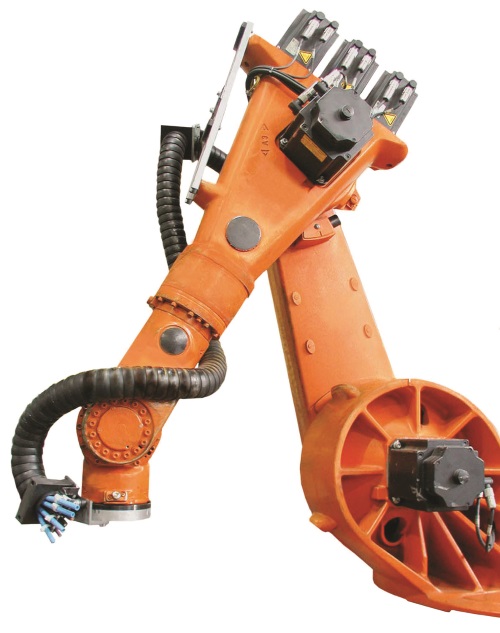
Dan Thompson, junior product manager for Energy Chain Systems with igus, concurred, saying that the production side of the automotive industry has been using more cable carriers because of changes in production methods. “In the past, vehicle frames were made of steel, which were welded robotically. The dress package for the welding robots mainly consisted of copper wires, which were relatively easy to guide, and did not always need to have a defined bend radius,” he said. “Recently, the trend has been to switch from steel frames to aluminum, joining the pieces with adhesives and robotically driven screws as opposed to welds. To avoid kinking in these systems, the robotic screw feed tube must be carefully guided. igus currently has several installations in various automotive plants that use our Triflex R cable carrier to route these feed tubes and maintain a defined bending radius.”
In addition, said David Smith, director of sales for U.S. Tsubaki Power Transmission’s KabelSchlepp Div., changes in the vehicles themselves have led to changes in how cable carriers are manufactured.
“About 15 years ago, KabelSchlepp was the first company to put cable tracks on vehicles,” he said. “They are all over minivan doors, underneath seats on SUVs and the rear hatch.”
Because of this increase in volume and the prices it had to reach to meet automakers’ targets, KabelSchlepp had to change the way it manufactured its carriers, leading to 24-hour production in a hands-off environment. “When the cable tracks come out of the injection molding machine, they’re preassembled (by robots) to the right length and ready to be installed and just ready to go in the box.”

Thompson added that automobile manufacturers typically have very strict requirements for carriers. The carriers need to be ultra-low cost, usually a single-piece molded design that can withstand high cycles and a wide range of environments.
Other advances in materials have helped the industry make great strides into new areas, too. For example, said Smith, there has been a dramatic reduction in weight of steel carriers, which lowers the motor forces used to move them. Also, there has been a move to silent designs and improved speeds so the tracks can travel faster than in the past. In the end, said Smith, “Everybody’s trying to increase productivity. Cable tracks continue to improve along with the machinery.”
Thompson, added that by testing various geometries, igus has been able to reduce the weight of its cable carriers. “Lighter carriers are capable of carrying higher fill weights, as they require less support for their own weight,” he said.
And by refining the internal geometry of carrier links, igus has been able to create a “brake” feature inside the links, effectively slowing the link-to-link connection as maximum travel is reached, allowing for quieter operation.
Cunningham added that new materials and coatings have let Dynatect penetrate new industries that need high-strength and corrosion-resistant cable carriers. Cable carriers come in a variety of new materials, such as high-grade stainless steel and even exotic metals like titanium, as well as with specialty non-reflective and wear- and corrosion-resistant coatings. For example, Cunningham said that aerial work platforms require lightweight and high-strength cable carriers to reduce overall machine weight and increased performance.

Finally, the move to modularity and preassembled carriers is becoming more commonplace. “While many customers are pushing for standard systems for simplicity and economy, their applications often demand features that are not available on standard, cookie cutter designs,” Cunningham said. “As a result, modular systems that are easily customizable with standard, add-on components are becoming even more common place.”
As for preassembled designs, they help reduce overall cost and assembly time for cable-carrier customers. For example, said Thompson, “All components are ordered through a single supplier, and are assembled ahead of time to ensure compatibility and fit. The systems then ship and arrive at the customers’ site as a true plug-and-play unit, enabling installation in a matter of minutes instead of hours or days.”
Smith said that in the big scheme of things, the cables and hoses are actually the expensive item. “The cable track is there to prolong the life of the cables and hoses. It’s much more valuable, that cable and hose package, than the carrier itself,” he said. “And that process increases our relationship with our customers, because as we take more components, we’re basically taking responsibility for that whole segment.”

Leave a Reply
You must be logged in to post a comment.