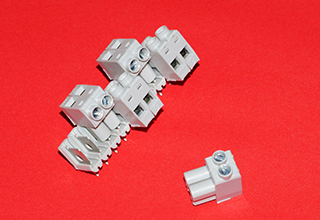
 Terminal blocks that can be plugged in both horizontally, as well as vertically, offer developers a high degree of flexibility. It’s the same in development too: The proof of the pudding is in the eating. Particularly cable outlets are usually there where you least often need them. Whether horizontal or vertical orientation to the circuit board can rarely be defined with certainty at the beginning of development. So there is always switching between terminal blocks for which the cables either exit vertically or horizontally. Wouldn’t it be practical to have a cable plug-in system that allowed both possibilities? Just that this is the advantage of the 3857 series (cable-side) and 3867 (PCB-side) of the WR-TBL terminal block series from Würth Elektronik. The male connector on the PCB allows the mating connector to be plugged-in with either a 90° or a 180° cable outlet. Rather than having to revert to a new component, you just turn the existing one around and therefore save valuable time. And to make assembly even quicker, the terminal blocks are available from 2 to 18 pole as standard and are extremely easy to separate to a smaller number of poles using a conventional cutter knife.
With a pitch of 5.0 mm, the pluggable version of the WR-TBL series allows connection of cable cross-sections from 24 to 12 AWG (0.205 to 3.32 mm2). Moreover, they distinguish themselves with a current carrying capacity of 14A (UL) and 16A (VDE) and a working voltage of 300 VAC (as per UL) and 250 VAC (VDE) respectively. Another specific feature is the solid contacts that also predestine the terminal blocks for development.
But they are outstandingly suited for series production too. On customer request, coding is available for series production – left (beige, 691 399 900 004S) and right (black, 691 399 902 104) – to restrict the plug-in direction. Incidentally: the WE Plus Service undertakes coding of small quantities up to 500 units from stock within four days.
Furthermore, the terminal blocks offer an essential advantage for use in series production: The complete component series comes ex works with glow-wire tested to 850 C and can therefore be used in household appliances that are not operated under supervision. And this by no means only includes washing machines, fully automatic coffee machines etc. According to IEC 60335-1 this covers all electrical applications, i.e. also controllers for roller shutters, heating systems, lifts or underground car parks. For all these unattended applications in which a current of more than 0.2A flows, the use of glow-wire tested components is mandatory to protect the consumer against fire in the event of an electrical malfunction in their absence.
Three IEC standards define compatibility with IEC 60335-1: The glow-wire test method GWT (IEC 60695-2-11), the flammability index of the material GWFI (IEC 60695-2-12) and the ignition temperature of the material GWIT (IEC 60695-2-13). According to the approach defined in IEC 60695-2-10, a glow-wire loop is heated up to temperatures of 500°C to 960°C. The specimen (GWT) or the basic material in a defined thickness of 0.1 to 6 mm (GWFI and GWIT) is then held for 30 seconds against the glowing wire. Beneath the specimen there is a sheet of tissue paper that must not ignite (GWT and GWFI). If there are no flames or afterglow and the flames or afterglow extinguish within 30 seconds after removal of the glow-wire and the tissue paper does not ignite, then the GWT is passed. If the specimen is not completely consumed, the GWFI is also positively tested. GWIT is passed if there is no ignition or if flames extinguish within 5 seconds before or after removing the glow-wire and the specimen has not been completely consumed.
The 3857 and 3867 series terminal blocks are the only ones in the WR-TBL family that are glow-wire tested to 850°C. Würth Elektronik eiSos will provide the customer with the relevant test documentation on request.
Würth Elektronik
we-online.com

Leave a Reply
You must be logged in to post a comment.