
• Skip to primary navigation
  • Skip to main content
  • Skip to primary sidebar
  • Skip to footer
  • Advertise
  • Subscribe

Wire and Cable Tips

  • Basics of Wire and Cable
  • Industry News & Events
  • Blog
  • Markets
    • Automation
    • Construction/Off-Highway
    • Electronics
    • Food/Beverage
    • Medical/Pharmaceutical
    • Military/Aerospace
    • Offshore/Marine
    • Oil/Gas
    • Renewables/Energy Production
    • Robotics
    • Semiconductor
  • Products
    • Data Transmission
    • Networking
    • Power Transmission
  • Suppliers
  • Video

What are cable glands?

October 11, 2016 By Mary Gannon Leave a Comment

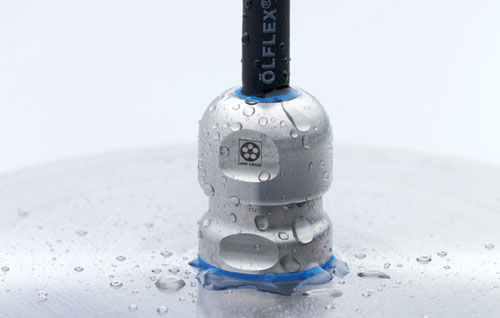
Lapp-Skintop-Hygienic cable gland
Skintop hygienic cable glands from Lapp.

Cable glands are devices that are critical when terminating cables in hazardous or harsh environments, where ingress protection, sealing and grounding is necessary to safely pass a cable, wire or tube through an enclosure. They provide strain relief and are also designed to contain electrical sparks or flames that may occur in hazardous environments. Additionally, they act as a seal, preventing outside contaminants from causing damage to the cable and electrical system, such as dust, dirt, and fluids. Finally, they prevent cables from twisting and being pulled out of the machine, as they help to provide a secure connection between the cable and machine to which it is attached.

They are designed for use with either armored or non-armored cable. When used with armored cable, they provide a ground to earth for the cable design.

A compression ring or O-ring sealing element tightens around the diameter of the cable, sealing any dangerous currents, sparks or flames from entering the machinery to which the cable leads.

They can be made of a variety of metals and plastics, depending on their application, including stainless steel, plastic, brass, and aluminum.

Because they are designed with safety in mind, it is important that cable glands carry one or more of the following electrical safety specification ratings, such as NEC, CEC, ATEX, IECx or similar depending on the country of origin and use.

It is critical to size your cable glands correctly, as only one cable can be used with one gland and the seal must be made with included O-ring, not with other elements the user may introduce such as tape.

Filed Under: Basics, Featured

Reader Interactions

Leave a Reply Cancel reply

You must be logged in to post a comment.

This site uses Akismet to reduce spam. Learn how your comment data is processed.

Primary Sidebar

EE ENGINEERING TRAINING DAYS

engineering

LEARNING CENTER

Design World Learning Center
“bills

RSS Current EDABoard.com discussions

RSS Current Electro-Tech-Online.com Discussions

  • Phone Charger 5v to 12v
  • Difference between TTL, RS232 and RS485
  • Wall Radiator Heating: Efficiency and Placement Questions
  • Assistance locating a 'trail' camera gadget, please ?
  • Projector focus circuit
“wire
EXPAND YOUR KNOWLEDGE AND STAY CONNECTED
Get the latest info on technologies, tools and strategies for EE professionals.

Footer

Design World Network

  • Design World Online
  • The Robot Report
  • Coupling Tips
  • Motion Control Tips
  • Linear Motion Tips
  • Fastener Engineering
  • Bearing Tips

Wire and Cable Tips

  • Subscribe to our newsletter
  • Advertise with us
  • Contact us
  • About Us

Copyright © 2026 · WTWH Media LLC and its licensors. All rights reserved.
The material on this site may not be reproduced, distributed, transmitted, cached or otherwise used, except with the prior written permission of WTWH Media.

Privacy Policy