
A Spanish manufacturer is using industrial robots equipped with cable guides from igus for quick and efficient riveting of aircraft fuselages on one of the world’s most widely-used planes.
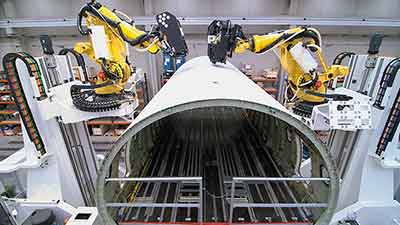
LOXIN (ARITEX GROUP) relies on cable guides made of high-performance plastic manufactured by igus, the Germany-based manufacturer of motion plastics. The guides are used on the assembly of Airbus A320 aircraft. Airbus is using the automated units developed by Loxin to increase production by 20% as it aims to catch up with demand. Airbus has sold approximately 6,000 jets, with another 8,000 on order. igus runs its North American operations out of Providence, R.I.
Rivets are inconspicuous fasteners that hold the fuselage parts of the aircraft together. Previously, the task took weeks as workers fastened the rivets into metal fuselages that weigh several tons.
For a long time, robots lacked the sophistication to handle the job. They needed more than just flexibility to reach every point of a fuselage. The LOXIN robots had to master several work steps, including drilling, milling to riveting, all with a precision of 0.2 millimeters.
Fuselages are riveted together by 6-axis robots from LOXIN
LOXIN 2002 succeeded in automating the riveting process. The multi-axis robots work to the left and right of the raised fuselage. The robots are mounted on platforms that can be raised up to a height of several meters by linear units — similar to a forklift (Figure 1). Arriving at the right height, the heavy robot weighing tons, moves to the operating point with millimeter accuracy over six axes. It drills a hole in the metal, mills a recess for the rivet head, vacuums up the dust, applies a sealant and sets the rivet.
Depending on the fuselage section, the robots must constantly change the angles and diameters during drilling, milling and riveting. But this flexible multitasking was not the only hurdle that LOXIN had to overcome during development.
Challenge: cables must withstand the complex movements
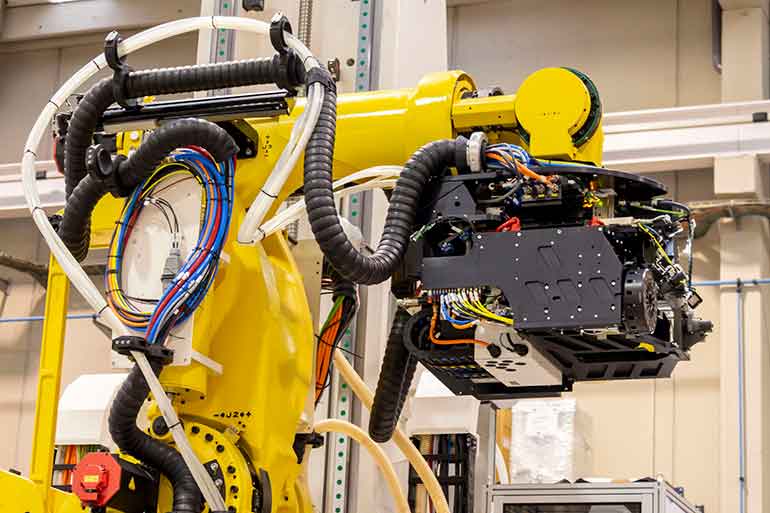
Six axes are used to move the head to any part of the fuselage. Energy supply is equally complicated. The tools on the robot’s end effector are connected to numerous energy, pneumatic and data cables. And these cables must follow the contorted movements of the arm perfectly, even at high speed, without rubbing against each other or knocking against the sensitive surface of the fuselage. Otherwise, long downtimes due to cable breaks and damage to the aircraft could occur.
In search of a reliable energy supply system, LOXIN compared systems from several manufacturers. “For a long time, we could not find a robust and reliable solution,” said Unai Martínez, Chief Engineer at LOXIN. “The number of cables and the weight was a problem.” LOXIN had experimented with corrugated tubes. Due to the rapid wear from friction, they broke easily. In everyday work processes, material failure would have meant replacing the entire tube, including removing the cables on the heads. A worst-case scenario would have resulted in a shutdown for several days.
Solution: 3D cable guides ensure freedom of movement
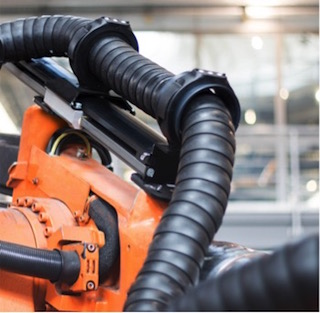
LOXIN finally found what it was looking for in Germany with igus. The range includes, among others, the triflex series. These are hose-like protective cages made of wear-resistant high-performance plastic, which follow even the wildest three-dimensional movements of industrial robots. Inside, the cables for data, pneumatics and energy supply are securely fixed and protected against wear. “The cables are protected against mechanical stress due to tensile load, torsion and expansion. This protection is particularly important when the robot heads take their maximum position,” Martínez said.
To ensure that the triflex energy chains mounted on the right and left of the arm move as close to the arm as possible and do not hit the aircraft, LOXIN uses the triflex RSE retraction system (Fig. 2). If the robot arm returns to its original position after a movement, the mechanical system retracts the chain. Round brackets, which are mounted on the arm, ensure safe guidance. The robot arm has full freedom of movement, without having the parts of the chain rub against each other or form loops.
“The igus energy chain also has a much better friction behavior than the corrugated tube and will not break and cause a stoppage,” Martínez said. And if a chain-link reaches the end of its service life, it can be replaced in a few simple steps. By using the triflex chains in conjunction with the triflex RSE retraction system, LOXIN has also been able to achieve better mobility of the robots, which can now simplify their work steps around the fuselage even more easily, saving valuable assembly time.
Energy chain allows circular movements of 540°
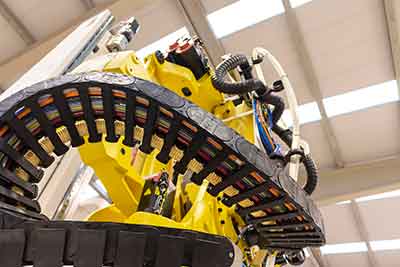
Another product from Cologne is used on the robot arm. The twisterchain is an energy chain that protects the cables from the base of the robot arm to the first axis (Fig. 3). The chain moves in a guide trough. If the robot arm turns, the chain folds as the upper run of the chain rests on the lower run. The chain allows a circular movement of up to 540° at speeds of up to 1 m/sec. Since it also consists of high-performance plastics, it is wear-resistant. Tests in the igus test laboratory have proven that the service life of the energy chain is over one million cycles.
“We are very satisfied with the solution, as our plants now have less downtime,” Martinez said.
LOXIN was presented with the 2018 vector award for the challenging energy supply solution. This award is organized by igus every two years and its winners are chosen by an independent jury.
igus
igus.com

Leave a Reply
You must be logged in to post a comment.